
Real Estate Property Matching: Find the Right Buyers Faster
A new property enters your inventory.
It has three bedrooms, a swimming pool, a great location, and falls within a price range several of your buyers have discussed.
Now comes a surprisingly difficult question:
Which clients should you contact?
For an agent with ten active buyers, the answer may be easy.
For someone managing 50, 100, or several hundred prospects, it becomes much harder.
Buyer requirements change. Budgets shift. People consider different neighborhoods. New properties arrive while others are reduced in price or return to the market.
Trying to keep every possible connection in your head eventually stops working.
That’s where real estate property matching can help.
What Is Real Estate Property Matching?
Property matching compares what a buyer wants with the characteristics of available properties.
At its simplest, that might mean:
Buyer wants three bedrooms → property has three bedrooms.
But useful matching goes considerably further.
A buyer profile might include:
- Budget
- Minimum bedrooms
- Minimum bathrooms
- Property type
- Preferred neighborhoods
- Desired amenities
- Property size
- Location
- Purchase timeline
- Other preferences
The property already contains many of the same characteristics.
Once both sides contain structured information, software can compare them.
The result isn’t a decision about which property someone should buy.
It’s a shortlist of potentially relevant opportunities.
The Problem With Relying on Memory
Experienced real estate professionals often have impressive knowledge of both their inventory and clients.
That expertise remains enormously valuable.
But memory doesn’t scale particularly well.
Imagine an agent working with 75 buyers.
Some want houses.
Others want condominiums.
One needs four bedrooms.
Another insists on a pool.
Someone wants to live in Centro.
Another prefers northern Mérida.
Several buyers have budgets around $400,000, but one might stretch to $475,000 for the right property.
Then five new listings arrive.
How many possible buyer-property combinations now exist?
The agent may remember the most obvious matches.
The danger lies in the less obvious ones.
Property Matching Starts With Better CRM Data
Matching software cannot understand buyer requirements that were never recorded.
That’s why a real estate CRM becomes an important part of the process.
A contact record containing only:
John Smith
[email protected]
555-1234
provides almost nothing useful for property matching.
Compare that with:
Budget: Up to $450,000
Bedrooms: 3+
Property type: House
Preferred areas: Centro, San Sebastián
Amenities: Pool, courtyard
Timeline: Within six months
Now the system has something meaningful to work with.
This is why buyer qualification shouldn’t be viewed simply as another form to complete.
Structured preferences can become actionable data.
Properties Need Structured Data Too
The same principle applies to listings.
A beautiful property description is useful for humans.
It’s much less useful for a matching engine.
Consider:
“A magnificent residence offering generous spaces and a wonderful lifestyle in one of the area’s most desirable locations.”
That sounds pleasant.
But how many bedrooms does it have?
What’s the price?
Does it have a pool?
What neighborhood is it in?
Software needs structured information such as:
Price: $425,000
Bedrooms: 3
Bathrooms: 3
Property type: House
Neighborhood: San Sebastián
Pool: Yes
The description can still tell the property’s story.
The structured fields make the property computable.
Not Every Requirement Has Equal Importance
Property matching becomes more interesting when we recognize that buyer preferences aren’t always absolute.
A buyer might say:
“I’d really like four bedrooms, but three would work if there’s a separate office.”
Another might say:
“I’d prefer Centro, but I’d consider San Sebastián or Santiago.”
Someone with a $400,000 target budget might consider a $420,000 property.
This means matching doesn’t always need to produce a simple:
MATCH / NO MATCH
A score can be more useful.
For example:
92% match
could indicate that the property satisfies nearly everything the buyer requested.
A 70% match might still deserve attention if the differences are relatively minor.
The purpose of a score isn’t to pretend software understands the buyer better than the agent.
It helps the agent decide where to look first.
Explain Why a Property Matches
A percentage by itself isn’t particularly useful.
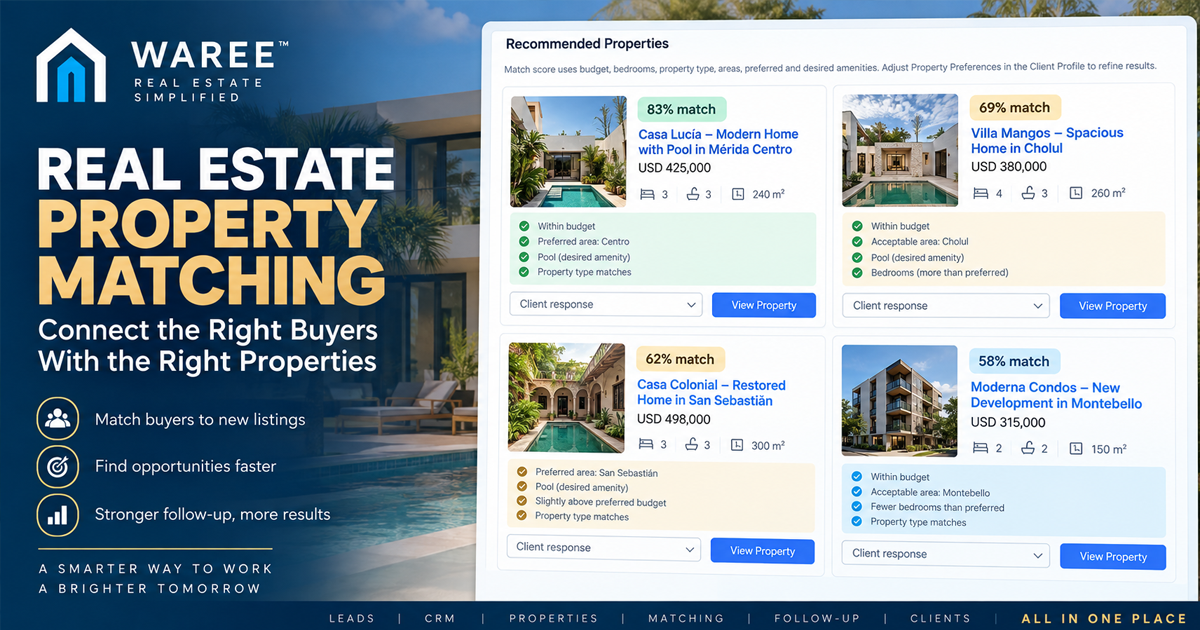
Why is the property an 83% match?
Good property-matching software should provide context.
For example:
Comfortably within budget
3 bedrooms meets preference
Preferred property type
Preferred neighborhood
1 desired amenity matched
Or perhaps:
Slightly above preferred budget
Fewer bedrooms than requested
Preferred area
That explanation allows the agent to quickly determine whether the recommendation makes sense.
Transparency is especially important when software is helping prioritize human decisions.
Matching Should Work in Both Directions
Most people think about matching from the buyer’s perspective:
Buyer → Find properties
That’s useful.
But the reverse is equally valuable:
New property → Find buyers
Suppose a new listing is added this morning.
Instead of waiting for agents to remember who might want it, the system can compare the property against existing buyer profiles.
Suddenly the listing may have:
4 strong matches
7 possible matches
Those become immediate marketing and follow-up opportunities.
This is where property matching starts affecting productivity rather than simply search.
New Listings Create Follow-Up Opportunities
This connects directly with real estate lead follow-up.
Imagine a buyer you haven’t spoken with in three weeks.
A property enters the system that strongly matches their requirements.
Now there’s a legitimate reason to reconnect.
Instead of:
“Just checking in to see if you’re still looking.”
the agent can say:
“A property became available this morning that matches several of the things you told me you wanted.”
The second message provides value.
Property matching gives follow-up context.
Price Changes Can Create New Matches
New listings aren’t the only trigger.
Suppose a property was originally priced at $525,000.
One of your buyers has a maximum budget around $475,000, so the property wasn’t particularly relevant.
Later, the price drops to $479,000.
That change could make the property worth reconsidering.
A connected system can potentially recognize that relationship.
The property didn’t change.
The match did.
This illustrates why property matching becomes much more powerful when it’s connected to current listing information.
Buyer Preferences Change Too
The other side of the equation isn’t static either.
A buyer initially says:
Budget: $350,000
After several weeks of searching, they revise it to:
Budget: $425,000
That change can reveal properties that weren’t previously relevant.
The same thing can happen with neighborhoods, bedrooms, property types, or amenities.
Updating the buyer’s preferences should therefore affect future match results.
One authoritative client profile is much easier to maintain than requirements scattered through emails and notes.
Matching Is Especially Useful With Large Inventories
Property matching becomes increasingly valuable as inventory grows.
An agent with five listings can probably remember them.
A brokerage with hundreds cannot realistically compare every property against every active buyer manually.
The same applies to external listing feeds.
As real estate listing automation and listing-feed integrations bring larger inventories into a platform, matching helps agents make sense of that volume.
More listings aren’t automatically more useful.
The real value comes from identifying the listings relevant to a particular client.
International Real Estate Makes Matching More Complicated
International property searches introduce additional variables.
Currency is an obvious example.
A property may be officially listed in Mexican pesos while the buyer thinks in U.S. dollars, Canadian dollars, euros, or another currency.
Measurements create another issue.
One buyer thinks in square meters.
Another understands square feet.
Neighborhood terminology and property types can also vary by country.
The underlying matching system should work from normalized property information while presenting results in a way the agent and buyer understand.
This is one reason structured property data matters so much.
AI Can Help Interpret Less Structured Preferences
Not every buyer describes what they want using neat database fields.
Someone might say:
“We want something with character, preferably colonial, where we can walk to restaurants. We’d like a pool but could live without one if the house has a great courtyard.”
That’s much richer than:
Bedrooms: 3
Budget: $500,000
Artificial intelligence can potentially help interpret this kind of unstructured information and assist in turning it into useful preferences.
This is where AI agents for real estate can complement traditional matching technology.
AI can help understand language.
Structured matching can help compare known requirements consistently.
The two approaches don’t have to compete.
They can work together.
Matching Should Assist Agents, Not Replace Them
A 95% match doesn’t mean someone will love a property.
Human preferences are complicated.
A house can meet every requirement on paper and still feel wrong when the buyer walks through the door.
Another property may violate two stated preferences but immediately capture their attention.
Experienced agents understand this.
Property matching should therefore be treated as a decision-support tool, not an automated decision-maker.
Its job is to surface possibilities.
The agent provides judgment.
How WAREE Property Matching Works
WAREE connects property matching directly with the CRM and property inventory.
Buyer preferences can be recorded as part of the client profile.
Available properties already contain structured information such as price, bedrooms, property type, area or neighborhood, and amenities.
WAREE can compare those datasets and calculate potential matches.
The system doesn’t simply display a percentage.
It can explain why a property received that score.
For example:
Comfortably within budget · 3 bedrooms meets preference · Preferred property type · 1 desired amenity matched
The agent can then record the client’s response to the recommendation.
That creates another useful piece of relationship data.
From Match to Client Response
A recommendation isn’t particularly useful if nothing happens afterward.
Suppose WAREE identifies a strong match.
The agent contacts the buyer.
The buyer says:
Very interested
or:
Not interested
That response matters.
It can help the agent understand the client’s preferences more accurately.
Perhaps the buyer said they wanted modern construction but keeps responding positively to colonial homes.
Real-world behavior sometimes tells us more than the original questionnaire.
Over time, the combination of stated preferences and actual responses can provide a richer picture of what the client wants.
Property Matching Becomes Part of a Larger Workflow
This is where WAREE’s connected approach matters.
Property matching doesn’t exist by itself.
It can sit inside a broader sequence:
Lead → CRM → Buyer Qualification → Preferences → Property Matching → Client Response → Follow-Up
Then new inventory creates another loop:
New Property → Matching → Existing Buyers → Follow-Up
Marketing can create new leads.
Those leads can enter the CRM.
The CRM can produce new matches.
Matches can generate meaningful communication.
This is the same principle behind all-in-one real estate software: individual tools become more useful when they share information.
Stop Searching Your CRM Manually
Agents shouldn’t have to open every client record whenever a new property becomes available.
They also shouldn’t need to search through every listing whenever a buyer changes their requirements.
Software is extremely good at comparing structured information.
Let it.
The agent’s time is better spent reviewing the results, understanding the client’s needs, presenting the right opportunities, and managing the relationship.
Real estate will always depend heavily on human judgment.
Property matching doesn’t change that.
It simply gives that judgment a better starting point.
Because sometimes the right buyer for your newest listing is already in your CRM.
You just need a better way to find them.