Real Estate CRM for Independent Agents: What Features Actually Matter?
Independent real estate agents have a unique technology problem.
They need many of the same capabilities as a large brokerage, but they don’t have an entire staff available to manage leads, update databases, follow up with buyers, organize listings, and keep track of every client interaction.
That’s why choosing the right real estate CRM for independent agents matters.
Unfortunately, more features don’t necessarily make a better CRM.
A system can have hundreds of options and still fail at its most important job:
Helping an agent build and maintain relationships that lead to business.
So, what should an independent real estate agent actually expect from a modern CRM?
A Real Estate CRM Should Be More Than a Contact List
At its most basic level, CRM stands for Customer Relationship Management.
Many systems begin with familiar information:
- Name
- Email address
- Phone number
- Notes
- Lead status
- Last contact
That’s useful, but real estate relationships contain much more information.
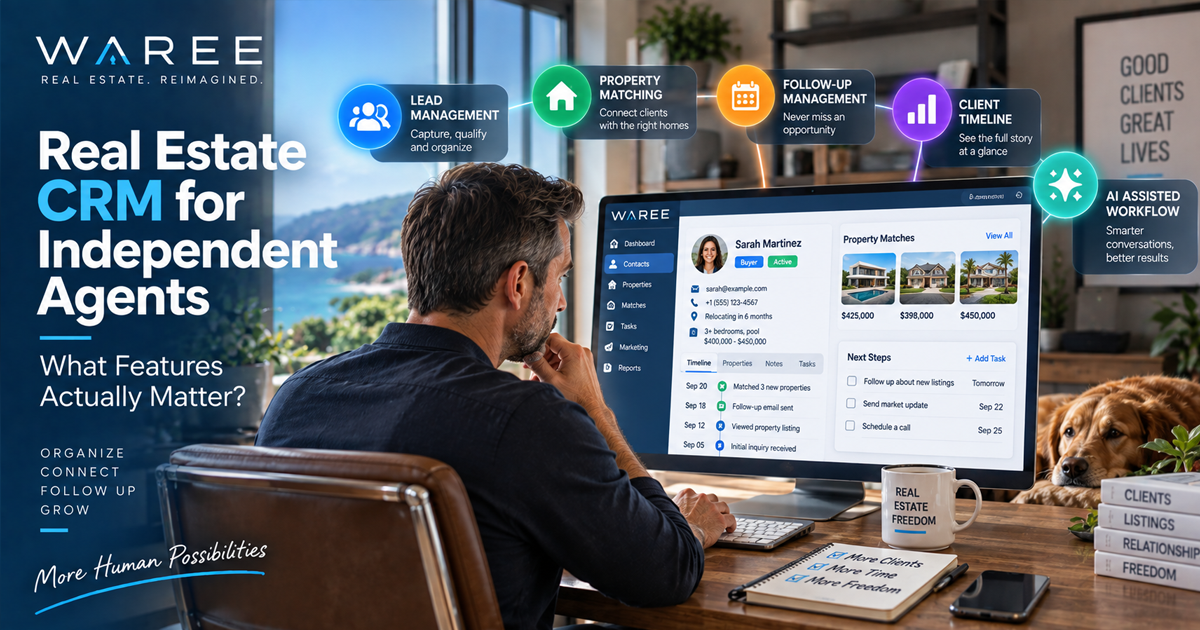
A buyer may want a three-bedroom home with a pool in a specific neighborhood. They might have a $400,000 budget and plan to move within six months.
A seller has an entirely different set of information surrounding their property, motivation, timeframe, asking price, and communication history.
Simply knowing someone’s phone number doesn’t tell an agent what that person needs.
A useful real estate CRM should help answer a more important question:
Why is this person in my database?
1. Buyer and Seller Profiles
Buyers and sellers shouldn’t be treated as identical contacts.
For buyers, a CRM should be able to organize information such as:
- Preferred locations
- Budget
- Property type
- Bedrooms and bathrooms
- Desired amenities
- Purchase timeframe
- Financing status
- Properties of interest
Seller information may include property details, expected selling timeframe, motivation, listing status, and previous conversations.
Capturing this context makes the CRM useful rather than simply organized.
When an agent opens a client’s record three months later, the important information should still be immediately understandable.
2. Lead Qualification
Not every inquiry represents the same opportunity.
One person might casually request information about a property.
Another might be relocating next month, already have financing, and be actively searching within a defined budget.
Those leads deserve different levels of attention.
A modern real estate CRM should help agents organize qualification information without forcing them to rely entirely on memory.
Qualification can include factors such as:
Intent + Timeline + Budget + Readiness + Engagement
The objective isn’t to assign a human being an arbitrary number.
Instead, qualification helps the agent determine where attention may be most valuable.
3. Property Matching
This is where a real estate CRM can become considerably more powerful.
Once a CRM understands what a buyer wants, it should be able to connect those preferences with available properties.
Suppose a buyer wants:
- Three or more bedrooms
- A swimming pool
- A particular neighborhood
- A maximum price of $450,000
When a matching property becomes available, the agent shouldn’t have to remember every client who might be interested.
Technology can help make that connection.
Property matching turns buyer preferences into useful information instead of notes that sit forgotten inside a CRM.
4. A Complete Client Timeline
Relationships develop over time.
An agent may speak with someone by email, record a property interest, schedule a follow-up, change their status, send them a listing, and update their requirements.
Those events tell a story.
A useful CRM should provide a timeline that helps the agent understand that story without searching through multiple screens or applications.
For example:
March 4: Buyer inquiry received
March 5: Client profile created
March 8: Interested in Property A
March 12: Budget updated
March 19: Property B matched
March 20: Follow-up sent
That context becomes particularly valuable when an agent hasn’t spoken with the client recently.
5. Follow-Up Management
A CRM full of contacts has very little value if nobody contacts them.
Follow-up is one of the most important jobs a CRM can support.
Traditional systems often handle this with reminders:
Call John on Tuesday.
That’s helpful.
Modern systems can go further by considering what has happened since the previous conversation.
Perhaps a matching property was added.
Maybe the buyer viewed several listings.
Their timeframe may be approaching.
Instead of merely reminding an agent that someone exists, the CRM can help explain why now might be a good time to reconnect.
6. AI That Understands CRM Context
Artificial intelligence becomes significantly more useful when it has appropriate context.
A generic AI tool knows nothing about an agent’s client unless someone explains the entire situation.
A connected system can work differently.
With controlled access to relevant CRM information, an AI follow-up agent can consider buyer preferences, timeline, status, previous activity, and matching properties before preparing a suggested communication.
That creates an important distinction.
Generic AI can help write:
“Just checking in to see if you’re still looking for a home.”
Context-aware AI might instead help prepare a message about a newly available property that matches what the client has actually been looking for.
The second message has a reason to exist.
7. Lead Capture Should Connect Directly to the CRM
Website leads shouldn’t have to be manually transferred into another system.
When someone submits a buyer inquiry, seller inquiry, property question, or qualification form, that information should be capable of becoming part of the CRM workflow.
Otherwise, the agent ends up with information scattered across email inboxes, spreadsheets, contact forms, and software applications.
Every additional handoff creates another opportunity for a lead to disappear.
The ideal workflow is much simpler:
Inquiry → CRM → Qualification → Matching → Follow-Up
Reducing the number of manual steps makes the process easier to maintain.
8. Social Contact Information Matters
Real estate conversations don’t happen exclusively through email.
Clients may first interact with an agent through social media and continue communicating there.
A modern CRM should therefore provide a way to retain appropriate social contact information alongside traditional email and telephone information.
The goal isn’t to collect every possible detail about someone.
It’s to help the agent remember where the relationship actually exists.
9. The CRM Should Connect With the Rest of the Real Estate Business
This may be the most important feature of all.
A CRM shouldn’t exist on an island.
Consider what happens when separate applications handle:
CRM → Properties → Website → Email → Marketing → AI → Follow-Up
Information has to continually move between them.
Sometimes that happens through integrations.
Sometimes it requires copying and pasting.
Sometimes it doesn’t happen at all.
An integrated real estate platform can create a different workflow:
Client → Preferences → Property Match → Communication → Engagement → Follow-Up
Everyone works from the same underlying information.
That connection can be more valuable than adding another hundred CRM features.
What Independent Agents Probably Don’t Need
Software companies often compete by adding features.
Independent agents should be careful not to confuse complexity with capability.
A CRM designed around massive brokerage teams may include extensive management features that a solo agent never uses.
Those features can make the system more expensive and harder to operate.
Independent agents generally need something different:
Enough capability to operate professionally without requiring someone to manage the software.
If updating the CRM becomes another full-time job, the CRM has failed.
What About AI Agents?
This is where real estate CRM technology is beginning to change.
As we discussed in our guide to AI agents for real estate, specialized AI agents can help with different parts of a real estate workflow.
A Follow-Up Agent can help identify clients who may deserve attention.
A Marketing Agent can help prepare relevant property communications.
A Listing Agent can help organize property information.
A Scout Agent can help identify and structure potential opportunities for review.
The CRM provides much of the context connecting those activities.
Without that shared information, each AI tool operates largely on its own.
With it, AI can become part of a coordinated workflow.
How WAREE Approaches Real Estate CRM
WAREE was designed around the idea that CRM, property management, matching, marketing, and automation shouldn’t behave like unrelated applications.
A client profile can contain more than contact information.
Buyer preferences can become structured data.
Properties can be matched against those preferences.
Client interests can be tracked.
Interactions can become part of a timeline.
Lead capture can feed into the CRM.
Follow-up can work from the same information.
And WAREE’s AI Agent Hub can use appropriate context to help the real estate professional manage the workflow.
The goal isn’t to build the CRM with the longest feature list.
It’s to build one that understands how real estate work moves from one step to another.
The Best CRM Is the One That Helps You Remember What Matters
Independent real estate professionals don’t need technology to replace relationships.
They need technology that helps them manage relationships better.
A good CRM should answer questions such as:
Who is this person?
What are they looking for?
How serious are they?
Which properties might interest them?
What has happened so far?
Who needs my attention today?
When a CRM can answer those questions quickly, it stops being a database.
It becomes part of the agent’s business.
And as AI becomes more deeply integrated into real estate technology, the quality of that underlying CRM context will become even more important.