AI for Real Estate Agents: What Can Actually Be Automated in 2026?
Artificial intelligence has quickly moved from an interesting experiment to an everyday business tool for real estate professionals.
But there is an important difference between using AI and actually automating a real estate business with AI.
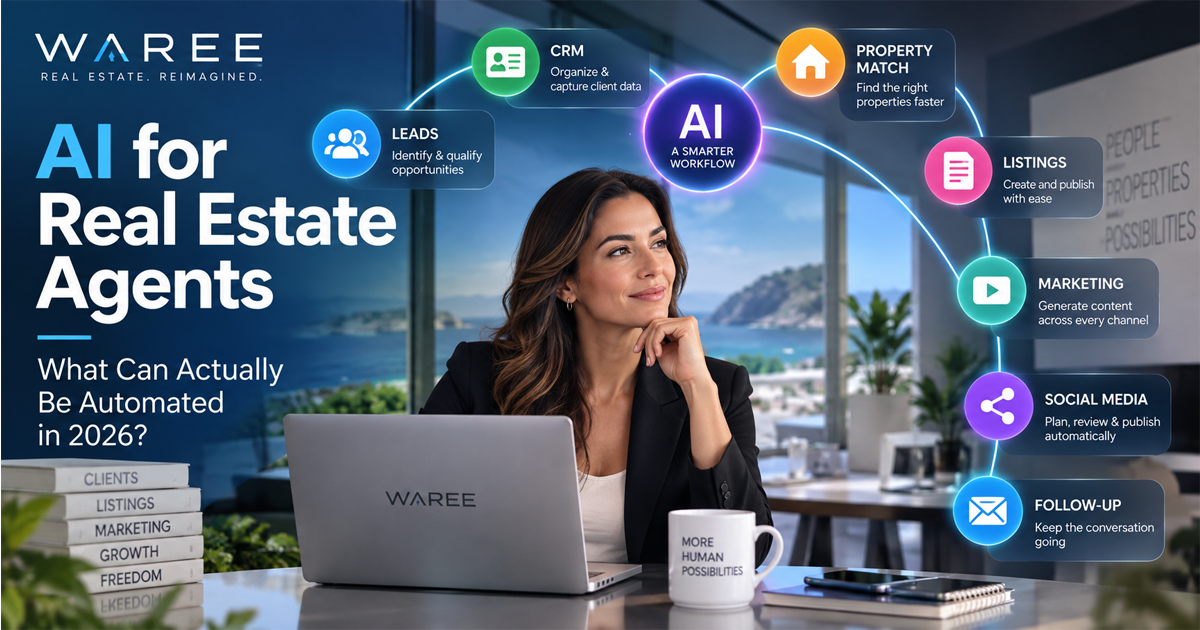
As of 2026, agents can use artificial intelligence to help identify leads, organize client information, create property listings, match buyers with properties, draft follow-up messages, produce marketing content, create listing videos, and prepare social media campaigns.
The bigger opportunity isn’t asking AI to write another property description.
It’s connecting these activities into a useful workflow.
AI Is Moving Beyond the Real Estate Chatbot
The first wave of AI tools was primarily generative.
An agent typed a request such as:
“Write a Facebook post for this property.”
AI produced the text.
Useful? Absolutely.
Automation? Not really.
The next generation is increasingly agentic. Instead of simply responding to individual prompts, AI agents can participate in multistep workflows involving CRM records, follow-ups, property information, marketing, and other business processes.
The National Association of REALTORS® has highlighted this transition, describing AI as moving beyond simple chatbots and content generation toward systems capable of handling complex, multistep processes.
That changes the conversation from:
“What can AI write for me?”
to:
“What work can AI help me accomplish?”
1. Lead Discovery and Qualification
One of the biggest challenges in real estate isn’t finding people. It’s identifying people who may actually be preparing to buy or sell property.
AI can help analyze incoming inquiries and other permitted lead sources to identify intent.
For example, there is an enormous difference between:
“Beautiful house!”
and:
“We’re relocating to Mérida in January and looking for a three-bedroom home under $400,000.”
The second person has revealed location, timeframe, property requirements, budget, and purchase intent.
AI can help recognize those signals, organize them, and create a structured lead for an agent to review.
The agent remains responsible for the relationship. AI simply helps make sure the opportunity isn’t overlooked.
2. CRM Organization
A traditional CRM often depends heavily on manual data entry.
An agent receives an inquiry, opens the CRM, creates the client, enters their requirements, adds notes, selects a status, and schedules a follow-up.
In reality, busy agents don’t always do all of that.
AI can reduce this administrative burden by helping transform conversations and inquiries into structured CRM information.
A buyer mentioning:
-
$500,000 maximum budget
-
three bedrooms
-
swimming pool
-
specific neighborhood
-
moving within six months
has already provided valuable search criteria.
Instead of leaving those details buried inside an email or message, AI can help convert them into usable buyer preferences.
That’s when a CRM becomes more than an electronic address book.
3. Buyer-to-Property Matching
Once buyer requirements are structured, another powerful automation becomes possible:
Property matching.
Instead of expecting an agent to continually compare every new listing against every buyer in the CRM, software can perform an initial comparison automatically.
A matching engine might consider factors such as price, location, bedrooms, bathrooms, property type, amenities, and other preferences.
AI can then help interpret less structured requirements.
For example:
“We’d really like something quiet but still reasonably close to restaurants.”
That’s harder to represent with a simple checkbox.
The objective isn’t for AI to decide which home someone should purchase. It is to help the agent identify potentially relevant properties faster.
4. Intelligent Follow-Up
Lead generation receives enormous attention in real estate.
Lead follow-up deserves just as much.
A valuable prospect can disappear simply because the agent became busy and forgot to reconnect.
Modern automation can look at CRM information such as the client’s status, interests, previous activity, property matches, and timeline to help determine when follow-up may be appropriate.
AI can also prepare the first draft.
Instead of sending everyone:
“Just checking in to see if you’re still interested.”
a system with sufficient context could prepare something relevant to the client’s actual situation.
The important distinction is context.
Good AI follow-up shouldn’t feel like mass email automation. It should help the agent continue a conversation that already exists.
For important client communications, human review remains essential.
5. Property Listing Creation
Property data often arrives in messy forms.
It may come from another website, an owner, a spreadsheet, an MLS or listing feed, or an agent’s notes.
AI can help convert that information into structured property data.
That can include:
-
property type
-
price
-
location
-
bedrooms and bathrooms
-
lot and construction size
-
amenities
-
descriptions
-
images
-
coordinates
-
additional property characteristics
The important word here is help.
Property information must remain accurate. AI should never invent a swimming pool, change the number of bedrooms, or embellish facts simply because they make a listing sound better.
The ideal workflow combines automation with human verification.
6. Property Marketing
Once a property exists in a listing system, agents frequently repeat the same work.
They create website copy.
Then Facebook copy.
Then another version for Instagram.
Then an email.
Then perhaps a flyer.
Then a video.
Much of the information already exists in the original property record.
An integrated AI system can use that property information as the source for multiple marketing assets while adapting the presentation for each medium.
This is fundamentally different from repeatedly copying property details into unrelated AI applications.
The property becomes the single source of truth.
7. Real Estate Video Creation
Video has traditionally required another set of software—or another service provider.
But property photography, property specifications, agent information, branding, and descriptions already contain most of what is required to create a basic listing video.
Automation can combine these assets into property walkthrough videos containing motion effects, captions, property information, music, branding, QR codes, and closing information.
AI can assist with captions and presentation while rendering technology assembles the finished video.
The result doesn’t eliminate professional videography for luxury or highly produced listings.
It creates another option for the many properties that otherwise wouldn’t receive video marketing at all.
8. Social Media Marketing
Social media is another logical area for automation.
A property already contains much of the information needed to create a social post.
AI can help transform that information into platform-appropriate marketing copy and prepare posts for publication.
However, this is another area where human-reviewed automation is preferable to blind automation.
An agent should know what is being published under their name.
The best system doesn’t remove the agent from marketing.
It removes repetitive work from the agent’s marketing process.
The Problem With Using a Different AI Tool for Everything
This leads to one of the biggest technology problems facing real estate professionals.
An agent can have:
a website,
a CRM,
an AI writing application,
a lead-generation service,
an email marketing system,
a property management tool,
video software,
social media software,
and another application for follow-up.
Each application may be excellent.
But they don’t necessarily know what the others know.
The CRM knows that Maria wants a home in a particular neighborhood.
The property system knows that a matching home was listed yesterday.
The video application knows nothing about Maria.
The email system may know Maria’s address but not what property she wants.
The AI writing application knows none of it unless somebody manually provides the information again.
Integration is becoming just as important as intelligence.
A Different Approach: Connected Real Estate AI
This is one of the ideas behind WAREE.
Rather than treating artificial intelligence as a separate chatbot sitting beside a real estate platform, we’re developing WAREE so automation can work with the information already inside the real estate workflow.
That includes property data, CRM information, buyer preferences, property matching, marketing, listing creation, video, social publishing, and follow-up.
WAREE’s AI Agent Hub divides these responsibilities among specialized assistants, including a Scout Agent, Listing Agent, Marketing Agent, and Follow-Up Agent.
The objective isn’t to create an artificial real estate agent.
It’s to give the real agent a digital team that can help with the repetitive work happening around them.
What Should NOT Be Completely Automated?
AI can accomplish a surprising amount, but that doesn’t mean everything should be automated.
Negotiations, pricing decisions, legal and contractual matters, disclosures, representation, sensitive client communications, fair-housing considerations, and professional judgment require appropriate human oversight.
Even when AI prepares something correctly 99 times, the 100th matters when it represents your business or affects a client.
The National Association of REALTORS® has emphasized this same principle as AI becomes more capable: use AI for the heavy lifting while retaining human judgment.
That’s a sensible model for real estate automation.
AI Should Give Agents More Time to Be Agents
The goal of AI in real estate shouldn’t be eliminating the real estate professional.
It should be eliminating unnecessary work.
Agents create value through relationships, local knowledge, negotiation, judgment, trust, and understanding what a client actually needs.
Spending twenty minutes copying property specifications between applications doesn’t strengthen any of those things.
Neither does forgetting to follow up with a buyer because their information was buried inside an inbox.
The most useful question for real estate professionals in 2026 therefore isn’t:
“Should I use AI?”
A better question is:
“Which parts of my business should technology handle so I can spend more time with clients?”
That’s where real estate AI becomes genuinely interesting.
And it’s the problem we’re building WAREE to solve.