How Many Software Tools Does a Real Estate Agent Really Need?
Running a modern real estate business can require an astonishing number of software tools.
There’s the website.
The CRM.
Property management or listing software.
Email marketing.
Social media.
Video creation.
Lead generation.
AI.
Analytics.
Maybe an MLS or external listing feed on top of everything else.
Individually, many of these tools can be excellent. The problem begins when a real estate professional spends more time moving information between applications than actually using it.
So, how many software tools does a real estate agent really need?
The answer isn’t necessarily one.
But it probably isn’t twelve, either.
The Real Estate Technology Stack Keeps Growing
Technology has solved countless problems for real estate professionals.
Need a website? There’s an application for that.
Need a CRM? Choose from dozens.
Want to create a property video? Another application can handle it.
Social media scheduling requires another login. Email marketing may require another database. Artificial intelligence often means opening yet another application and explaining the same property or client all over again.
Before long, an agent hasn’t built a technology stack.
They’ve built a collection of software subscriptions.
The important question isn’t how many applications an agent uses.
It’s how well those applications work together.
What Software Does a Modern Real Estate Agent Need?
Every business is different, but most real estate professionals need technology to handle several fundamental jobs.
Property Management
Agents need somewhere to create and maintain property listings.
That includes prices, descriptions, locations, photographs, amenities, property specifications, availability, and status.
For international agents, requirements may also include multiple currencies, different measurement systems, translations, and regional address formats.
Property information becomes the foundation for much of the rest of the business.
Customer Relationship Management
A CRM should help agents understand more than names and telephone numbers.
Useful client information can include buyer preferences, budget, desired locations, timeframe, property interests, previous conversations, social contacts, qualification information, and follow-up activity.
Ideally, CRM data should connect naturally with property information.
After all, buyers and properties are two sides of the same transaction.
Lead Capture
A beautiful website isn’t particularly useful if interested visitors disappear.
Buyer inquiries, seller inquiries, property questions, and qualification forms should have a clear path into the agent’s workflow.
If website leads arrive in an inbox and must later be manually entered into a CRM, another unnecessary step has already been created.
Property Matching
Once the system understands what buyers want and which properties are available, matching those two datasets becomes possible.
A buyer looking for a three-bedroom home under $500,000 shouldn’t depend entirely on an agent remembering that requirement when a suitable listing appears three weeks later.
Technology can help make the connection.
Follow-Up
Real estate leads often don’t convert immediately.
Someone who isn’t ready today may become an excellent client three months from now.
That makes follow-up essential.
A good system should help an agent understand who needs attention, why they may need attention, and what has happened previously.
Marketing
Every listing needs exposure.
Agents may need property descriptions, emails, social media posts, website content, advertising copy, and other promotional material.
Marketing technology can save enormous amounts of time.
The challenge is getting accurate property information into those marketing tools without continually entering it again.
Video
Property video has become another important marketing channel.
Yet creating a video traditionally requires moving photographs and property information into separate editing software or outsourcing the job entirely.
Automation can make video practical for listings that might otherwise never receive one.
Artificial Intelligence
AI now touches nearly every part of the real estate technology stack.
It can help organize information, identify opportunities, prepare marketing, assist with listings, suggest follow-ups, and analyze client requirements.
But AI introduces the same integration problem as every other tool.
An AI system is only as useful as the context available to it.
The Hidden Cost of Too Many Real Estate Apps
Software prices are easy to see.
The hidden costs aren’t.
Suppose an agent uses separate applications for their website, CRM, email marketing, video, social media, AI, and lead management.
Every system may contain overlapping information.
A client’s email address might exist in three databases.
A property description could exist in four.
When the price changes, how many places need updating?
When a property sells, does every marketing system know?
When a buyer changes their requirements, does the property matching application receive the update?
The real cost of fragmented software is often duplicate work and disconnected information.
The Copy-and-Paste Problem
Here’s a simple example.
An agent adds a new listing.
First, the property information goes into the listing system.
Next, the description gets copied into an AI application to create marketing text.
The photographs are downloaded and uploaded into video software.
Property details are copied again for social media.
Another version goes into an email marketing system.
Then a potential buyer responds.
Their information needs to go into the CRM.
The applications may all work perfectly.
The workflow doesn’t.
The agent has become the integration between the software.
Integrations Help—but They Don’t Solve Everything
Software integrations can dramatically improve this situation.
APIs and automation services allow applications to exchange information without constant manual intervention.
That’s valuable.
However, integrations introduce another layer that needs to be configured, maintained, and sometimes repaired when one service changes its API or data structure.
There’s also a fundamental difference between two applications exchanging data and multiple capabilities working from the same underlying data.
Both approaches have their place.
The second can simplify the workflow considerably.
When Separate Software Is Better
An all-in-one system isn’t automatically the correct answer.
Specialized applications can be exceptionally powerful.
A large brokerage with sophisticated requirements may need dedicated transaction-management software, enterprise analytics, specialized accounting systems, or custom marketing infrastructure.
Professional video production will outperform automated listing videos when cinematic production is justified.
A dedicated email marketing platform may provide capabilities beyond what an individual agent requires from an integrated system.
The goal shouldn’t be eliminating every outside application.
Instead, ask:
Does this separate tool provide enough additional value to justify another system, another integration, and another source of data?
If the answer is yes, use it.
When an Integrated Platform Makes More Sense
Integration becomes especially valuable when several activities depend on the same information.
Consider this sequence:
Lead → CRM → Buyer Preferences → Property Match → Marketing → Follow-Up
Each step depends on information created during the previous steps.
Keeping those capabilities connected means the agent doesn’t have to repeatedly recreate context.
The same principle applies to property marketing:
Property → Description → Photos → Marketing → Video → Social Media
The property information already exists.
Ideally, everything downstream should be able to use it.
AI Makes Integration Even More Important
This is where the technology landscape becomes particularly interesting.
As we discussed in our guides to AI for real estate agents and AI agents for real estate, artificial intelligence becomes much more useful when it can operate with appropriate business context.
Imagine asking a generic AI application:
“Who should I follow up with today?”
It can’t answer intelligently because it doesn’t know your clients.
A connected system can potentially consider CRM status, buyer preferences, property interests, timelines, recent activity, and new property matches.
The difference isn’t necessarily a smarter AI model.
It’s better context.
That leads to an important principle:
The future of real estate technology isn’t only about having more intelligence. It’s about connecting intelligence to the right information.
One Source of Truth
A useful way to think about integrated software is the concept of a single source of truth.
A property should have one authoritative record.
A client should have one authoritative profile.
Other features can use that information rather than maintaining slightly different copies.
If a property price changes, connected features should work from the updated price.
If a buyer’s budget changes, future property matches should reflect the new budget.
If a listing sells, marketing workflows should know its status has changed.
That sounds simple.
In practice, it solves one of the biggest problems created by fragmented technology.
The WAREE Approach
WAREE is being developed around this connected model.
Instead of starting with separate applications and trying to integrate them afterward, WAREE brings core real estate workflows together around shared property and client information.
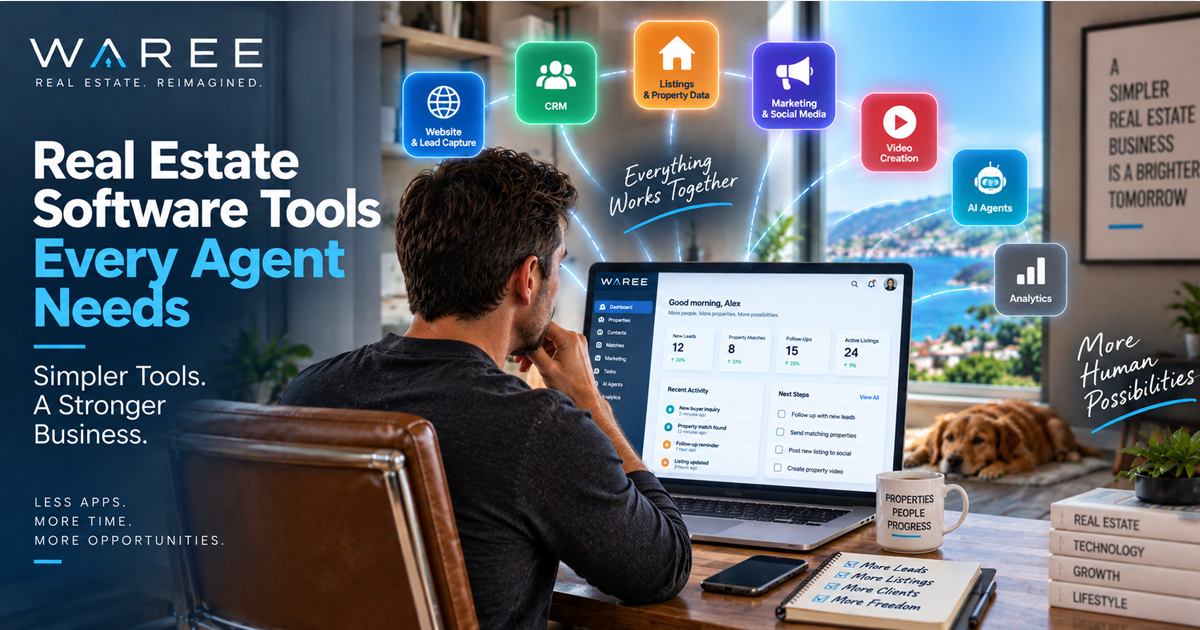
That includes property management, CRM, buyer qualification, property matching, lead capture, marketing, AI agents, follow-up, listing video creation, and social publishing.
The objective isn’t to claim that a real estate professional will never need another piece of software.
That’s unrealistic.
The objective is to reduce the number of separate systems required for the everyday work that naturally belongs together.
When a property already exists in WAREE, marketing shouldn’t require rebuilding it somewhere else.
When a buyer already exists in the CRM, matching shouldn’t require creating another buyer profile.
When AI assists with follow-up, the agent shouldn’t have to explain the entire client relationship again.
The information is already there.
So, How Many Software Tools Do You Really Need?
There’s no universal number.
A solo agent, independent brokerage, international property agency, and large enterprise all have different requirements.
A better goal is to minimize unnecessary fragmentation.
Look at every application in your current technology stack and ask:
What job does this perform?
Does another application already contain the information it needs?
Am I entering the same information twice?
Does it communicate with the rest of my business?
Would removing it make my workflow simpler or create a meaningful capability gap?
Those questions are much more useful than chasing the latest software tool.
Because the best real estate technology stack isn’t necessarily the one with the most applications.
It’s the one that lets the real estate professional spend the least amount of time managing technology—and the most time actually doing real estate.