AI Agents for Real Estate: What Are They and How Do They Work?
Artificial intelligence is already helping real estate professionals write property descriptions, create social media posts, answer questions, and prepare marketing materials.
But AI agents for real estate represent something different.
Rather than simply waiting for someone to type a prompt, an AI agent can be designed to assist with a specific job, use relevant business information, follow a defined workflow, and help move work from one step to the next.
Think of the difference this way:
Traditional AI answers a request.
An AI agent helps accomplish a task.
For real estate professionals, that distinction could change how technology fits into the daily business of finding clients, managing listings, marketing properties, and following up with opportunities.
What Is an AI Agent?
An AI agent is a software system designed to work toward a defined objective using information, instructions, tools, and predetermined boundaries.
With normal generative AI, an interaction might look like this:
Agent: Write a Facebook post for this property.
AI: Produces a Facebook post.
Useful? Absolutely. However, the AI isn’t really participating in the underlying business process.
Agentic technology can operate differently.
Imagine a marketing agent that already has access to approved property information. With an understanding of the property’s features, price, location, photographs, and agent information, it can use that context to prepare appropriate marketing material. The real estate professional no longer needs to repeatedly copy and paste the same information into another application.
That’s the beginning of an agentic workflow.
AI Agent vs. AI Assistant: What’s the Difference?
Although the terms are sometimes used interchangeably, there is an important distinction.
Generally, an AI assistant helps a person complete an individual task.
By comparison, an AI agent can be designed around an objective or workflow.
For example, an AI assistant might help write an email to a prospective buyer.
A real estate follow-up agent could go further by considering the buyer’s preferences, previous activity, timeline, CRM status, and relevant properties before preparing an appropriate follow-up for the real estate professional to review.
The difference isn’t simply better writing.
It’s context + workflow + action.
That combination makes AI agents particularly interesting for real estate.
Why Real Estate Is Well Suited to AI Agents
Real estate contains an enormous amount of repetitive work.
Information for a single property may need to be entered into a website, CRM, marketing system, social media application, email platform, video application, and other services.
Client information follows a similar path.
First, a potential buyer may appear as an inquiry. Next, their information needs to become a contact, their preferences need to be recorded, and appropriate properties need to be identified. Finally, follow-ups and marketing communications may need to occur.
None of these individual tasks is necessarily difficult.
The challenge comes from the number of tasks and the number of places where information lives.
AI agents become especially valuable when they can work with information already contained within that workflow.
One Giant AI Agent—or a Team of Specialists?
There are different ways to approach agentic AI.
One approach is to build a single AI system and ask it to handle everything.
Alternatively, specialized agents can be created with clearly defined responsibilities.
We prefer the second approach.
Think about a traditional real estate office.
You probably wouldn’t ask one employee to simultaneously handle lead research, listing entry, property marketing, social media, CRM administration, and every client follow-up.
Specialization makes responsibilities clearer.
The same concept can be applied to AI.
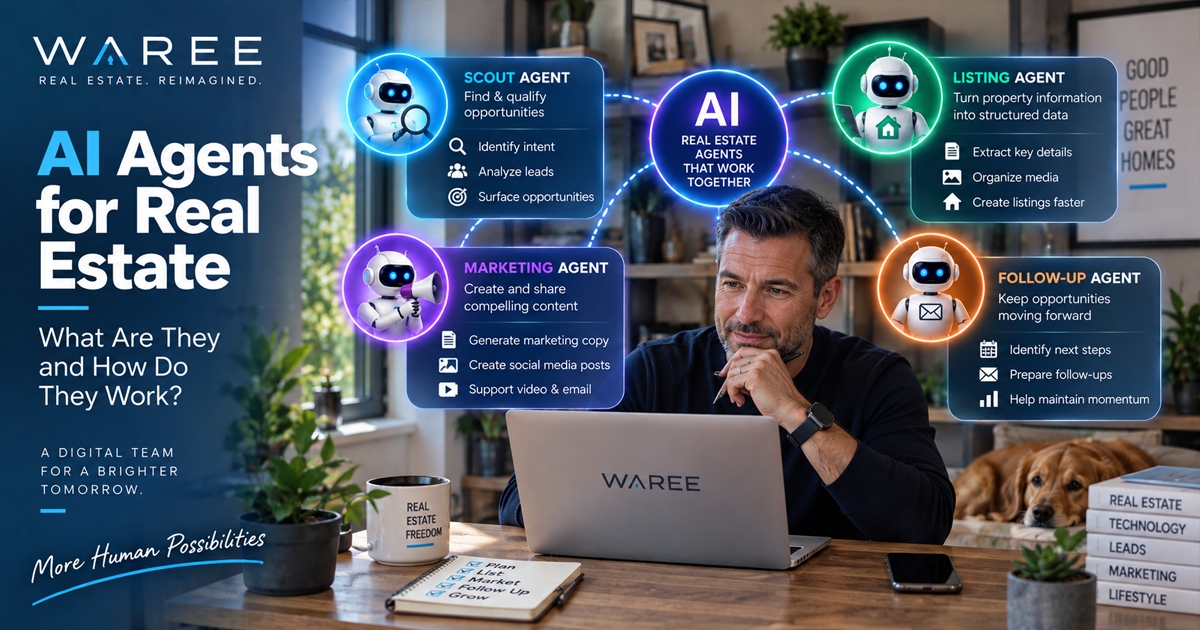
That’s why WAREE’s AI architecture is being developed around specialized agents rather than one enormous “Do Everything” AI button.
The Scout Agent: Finding Potential Opportunities
Finding potential clients is one of the first challenges for any real estate professional.
A Scout Agent can help identify and organize permitted lead opportunities from sources where potential buyers and sellers are expressing real estate intent.
What matters most is recognizing intent, not simply collecting names.
Consider these two statements:
“Beautiful house.”
and:
“We’re moving to the area in March and looking for a three-bedroom home near the city center.”
Those messages have dramatically different business value.
The second contains potential buyer intent, timeframe, bedroom requirements, and location preferences.
By recognizing these signals, a Scout Agent can organize useful information for human review.
Rather than deciding that someone is a client, it helps the real estate professional notice an opportunity that might otherwise be missed.
The Listing Agent: Turning Property Information Into Structured Data
Property information rarely arrives perfectly formatted.
Sometimes an owner sends an email. In other cases, another agent provides a webpage, a brokerage uses a spreadsheet, or a listing feed supplies structured data. Important details can also be buried inside lengthy property descriptions.
A Listing Agent can help extract and organize this information into the appropriate property fields.
For example:
- Price
- Location
- Property type
- Bedrooms
- Bathrooms
- Construction size
- Lot size
- Amenities
- Description
- Images
- Coordinates
However, this is also where AI requires boundaries.
If a source doesn’t say the property has a swimming pool, AI should not decide that it probably does.
Accuracy is more important than completeness.
For that reason, WAREE combines automation with review rather than assuming every AI extraction is correct.
The Marketing Agent: Turning Property Data Into Marketing
Once a property is entered, much of the information required for marketing already exists.
Why enter it again?
A Marketing Agent can work from approved property information to help create marketing content.
That might include:
- Property marketing copy
- Email campaigns
- Social media content
- Blog ideas
- SEO content
- Buyer-specific messaging
This is where integration becomes particularly powerful.
Instead of asking an unrelated AI system, “Write something about my new listing,” the Marketing Agent can work from the actual listing information already stored in the real estate platform.
In this workflow, the property record becomes the source of truth.
The Follow-Up Agent: Helping Opportunities Stay Alive
One of the easiest ways to lose a real estate opportunity is also one of the simplest:
Nobody followed up.
A buyer makes an inquiry.
After the agent responds, the buyer indicates they aren’t ready today. Three weeks pass, then six weeks. Eventually, that buyer may begin working with someone else.
A Follow-Up Agent can help prevent prospects from quietly disappearing from the pipeline.
Using CRM information such as client status, interests, timeline, previous interactions, and relevant properties, the system can help identify appropriate follow-up opportunities.
From there, it can prepare communications for the real estate professional to review.
The objective isn’t relentless automated messaging.
Instead, the goal is to make sure meaningful relationships aren’t forgotten.
Why the CRM Is So Important
AI agents become considerably more useful when they share context.
Suppose a CRM knows that a buyer:
- wants three bedrooms,
- has a $450,000 budget,
- prefers a particular neighborhood,
- wants a swimming pool,
- and expects to purchase within four months.
Now suppose a new matching property enters the system.
Suddenly, several parts of the platform can work together.
The CRM understands the buyer. Meanwhile, the property system contains the listing, and the matching system connects the two. Once a potential match exists, the Follow-Up Agent can recognize the opportunity while the Marketing Agent already understands the property.
That’s very different from having five separate applications that know nothing about one another.
The intelligence isn’t only in the AI.
It’s in the connections between the information.
What Does an AI Agent Actually “Know”?
This is an important question because AI agents aren’t human employees.
They don’t inherently understand your business.
To be effective, a real estate AI agent needs controlled access to appropriate context.
Depending on its job, that could include:
- Property information
- CRM records
- Buyer preferences
- Listing status
- Marketing information
- Previous activity
- Workflow instructions
Just as importantly, boundaries need to exist around what the agent can do with that information.
More access doesn’t automatically create better AI.
Instead, the objective should be giving an AI agent the information necessary for its assigned task—and no more than necessary.
Should AI Agents Be Allowed to Work Automatically?
Sometimes.
But “automatic” shouldn’t mean “unsupervised.”
Certain tasks are natural candidates for automation.
Organizing property data, identifying possible matches, flagging follow-up opportunities, or preparing marketing drafts can eliminate enormous amounts of repetitive work.
Other activities deserve human approval.
For example, an email sent to an important client should reflect the real estate professional’s judgment. Property descriptions should be factually verified, while social media posts should appropriately represent the agent or brokerage.
Pricing, negotiations, contracts, disclosures, fair-housing considerations, and legal matters require appropriate professional oversight.
The goal isn’t to remove people from the workflow.
It’s to decide where human judgment creates value and where repetitive work doesn’t require it.
AI Agents Should Work for the Real Estate Professional
There is understandable concern that artificial intelligence could eventually replace certain jobs.
For real estate, there is a more productive way to look at the technology.
At its core, real estate is a relationship business.
Clients depend on professionals for local knowledge, negotiation, judgment, reassurance, strategy, and representation.
When someone is making one of the largest financial decisions of their life, AI isn’t a substitute for the trusted professional sitting across the table.
Where technology excels is supporting that professional.
It can organize information, notice opportunities, prepare content, identify potential matches, and remind an agent when someone deserves attention.
That’s where we believe AI agents belong.
Building a Digital Real Estate Team
WAREE is being designed around a simple idea:
What if a real estate professional could have a digital team working alongside them?
Not replacing them.
Supporting them.
A Scout Agent helps identify opportunities.
Meanwhile, the Listing Agent helps organize property information. The Marketing Agent can transform that information into marketing, while the Follow-Up Agent helps keep client opportunities moving.
Because these specialized agents can work within the same real estate platform, they can operate from shared property and CRM information rather than functioning as disconnected AI tools.
That’s the real potential of AI agents for real estate.
The future may not be one giant AI application that does everything.
It may look much more familiar:
A team of specialists, each doing a particular job, working together around the real estate professional who remains in control.